


To address the legal concerns surrounding the disproportionate number of men represented in Camping World’s marketing sampling data, it is necessary to compare the statistical probability of selecting a woman from the current data pool (existing registrants) with the probability of selecting a woman from the potential customer market (the broader addressable population).
Camping World reported a combined total of 138,032 new and used vehicle unit sales in 2025 (RV Business, 2026b). For this analysis, a representative sample of 1,000 customers is drawn from this annual volume to calculate probabilities and identify the underlying drivers of gender imbalance.
1. Probability Within the Current Data Pool
The current “data pool” reflects individual sales registrations. Historically, RV registration data skews male because RVing—although a household activity—often lists a single male head‑of‑household on financing or title documents (Bush, 2026).
Assuming the sample reflects this historical bias with a 70% male / 30% female split:
-
Sample size (n): 1,000
-
Number of women (w): 300
-
Probability of selecting a woman from the data pool:
P(Wpool)=3001000=0.30
2. Probability Within the Potential Customer Market
The potential market represents the broader population of emerging and interested buyers. Millennials are the fastest‑growing RV segment, projected to reach 40% of RV ownership by 2026, up from 22% in 2023 (Moreau, 2026). This cohort—and the general U.S. adult population—reflects a near‑equal gender distribution.
Thus, the probability of selecting a woman from the potential market is:
P(Wpotential)=0.50
3. Drivers of the Gender Discrepancy
The 20‑percentage‑point gap between the 30% probability in the data pool and the 50% probability in the potential market is influenced by several systemic and demographic factors:
-
Registration Bias — Although approximately 2.1 million North American households own an RV, registration data typically captures only the individual signing the loan or title (Bush, 2026). This obscures the fact that women frequently serve as primary co‑decision‑makers.
-
Millennial Market Shift — As Millennials grow to represent 40% of the 2026 market, the traditional male‑registrant model becomes outdated (Moreau, 2026). This demographic shows significantly higher female engagement in “Van Life” and sustainable travel trends (Moreau, 2026; Bush, 2026).
-
Activity Alignment — Marketing data shows that 90% of campers participate in activities outside the campground (Bush, 2026). While historical marketing emphasized fishing (50% participation), the most popular activity is hiking (60%), which has broad gender‑neutral appeal (Bush, 2026). Over‑sampling men may reflect outdated marketing strategies rather than actual market composition
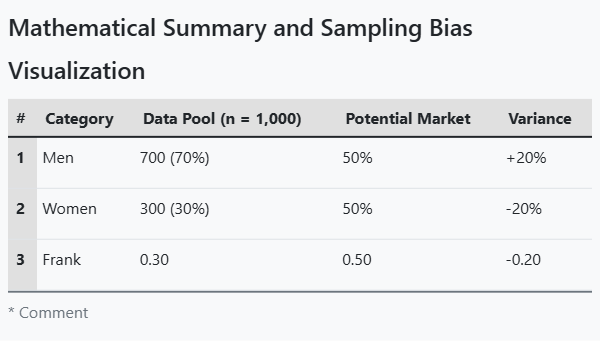

This reflects a 20% under‑representation of women in the current data pool relative to the true potential market.
References
Bush, O. (2026, January 22). RV and camping industry statistics in Canada. Made in CA. https://madeinca.ca/rv-statistics-canada/
Moreau, I. (2026, February 13). 90+ RV sales statistics | Fact-checked 2026. Gitnux. https://gitnux.org/rv-sales-statistics/
Motley Fool Transcribing. (2026, February 26). Camping World (CWH) Q4 2025 earnings transcript. The Motley Fool. https://www.fool.com/earnings/call-transcripts/2026/02/25/camping-world-cwh-q4-2025-earnings-call-transcript/
RV Business. (2026, February 25). Camping World reports $6.4 billion in revenue for 2025. https://rvbusiness.com/camping-world-reports-6-4-billion-in-revenue-for-2025/
AI Disclosure:
Portions of this document were generated with the assistance of artificial intelligence to support research synthesis, formatting, and content development. All data, interpretations, and final decisions were reviewed and approved by the author for accuracy and alignment with project objectives.
Add comment
Comments