

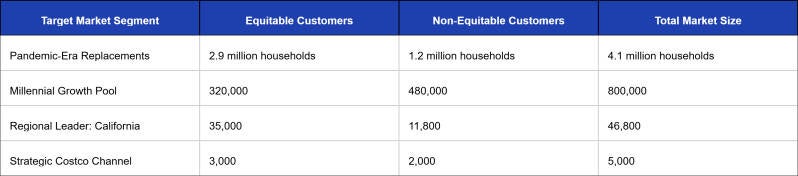
For the proposed “Equity‑First Transparency Gala & Great RV Giveaway,” the target customer pool is intentionally segmented to align with current market dynamics most notably the impending trade‑in cycle and the rapid rise of younger RV buyers. Camping World’s core audience includes the 4.1 million households who purchased RVs during the 2020–2022 pandemic peak and are now entering a manageable equity position, making them ideal upgrade candidates (Camping World Holdings, Inc., 2026). At the same time, Millennials represent a fast‑growing demographic, with ownership projected to increase from 22% in 2023 to 40% by 2026 (Moreau, 2026). These shifts create a unique opportunity to tailor the gala toward customers who are both financially and culturally primed for engagement.
To maximize reach and relevance, these customers are categorized into four strategic segments. Pandemic‑Era Upgraders consist of owners of 2020–2022 models who are positioned to leverage their equity for newer technology and updated floorplans (Camping World Holdings, Inc., 2026). Millennial Adventurers represent budget‑conscious first‑time buyers and “Van Life” enthusiasts seeking Class B conversions or sustainable, solar‑equipped units (Moreau, 2026; Bush, 2026). Costco Strategic Partners include high‑intent retail shoppers reached through the exclusive Costco partnership, which is expected to generate 3,000 to 5,000 incremental unit sales annually (Camping World Holdings, Inc., 2026; RV Business, 2026). Finally, Regional Growth Segments capture high‑volume markets such as California responsible for 15% of national RV sales—and the expanding Canadian market, where 2.1 million households own an RV and demand is projected to grow 4% in 2025 (Moreau, 2026; Bush, 2026).
Projected Cost and Strategic Justification
The projected cost of approximately $35 million reflects the EBITDA impact of the “strict and aggressive” inventory‑cleansing initiative required to clear Model Year 2025 units, which currently make up 18% of new assets (Camping World Holdings, Inc., 2026; RV Business, 2026). This investment is strategically justified by several long‑term benefits. First, operational efficiency will improve as clearing aged stock increases new‑unit turnover from 1.7 to a target range of 2.2–2.4, reducing floor‑plan interest and depreciation exposure (Camping World Holdings, Inc., 2026). Second, debt reduction becomes more achievable as increased sales volume supports the company’s goal of lowering net debt leverage to below 4.7x in 2026 (Camping World Holdings, Inc., 2026; RV Business, 2026). Finally, competitive positioning strengthens as transparent “out‑the‑door” pricing directly addresses customer frustration with hidden fees and counters the no‑haggle model used by rivals such as Bish’s RV (Reddit, n.d.; RV Dealers Boise, 2026). Together, these outcomes make the promotional investment both financially sound and strategically essential.
References
- Moreau, I. (2026, February 13). 90+ RV sales statistics | Fact-checked 2026. Gitnux. https://gitnux.org/rv-sales-statistics/
- RV Business. (2026, February 25). Camping World reports $6.4 billion in revenue for 2025. https://rvbusiness.com/camping-world-reports-6-4-billion-in-revenue-for-2025/
- Camping World Holdings, Inc. (2026, February 25). Q4 2025 earnings transcript. The Motley Fool. https://www.fool.com/earnings/call-transcripts/2026/02/25/camping-world-cwh-q4-2025-earnings-call-transcript/
AI Disclosure:
Portions of this document were generated with the assistance of artificial intelligence to support research synthesis, formatting, and content development. All data, interpretations, and final decisions were reviewed and approved by the author for accuracy and alignment with project objectives.
Create Your Own Website With Webador